
Purpose of the flight and payload description
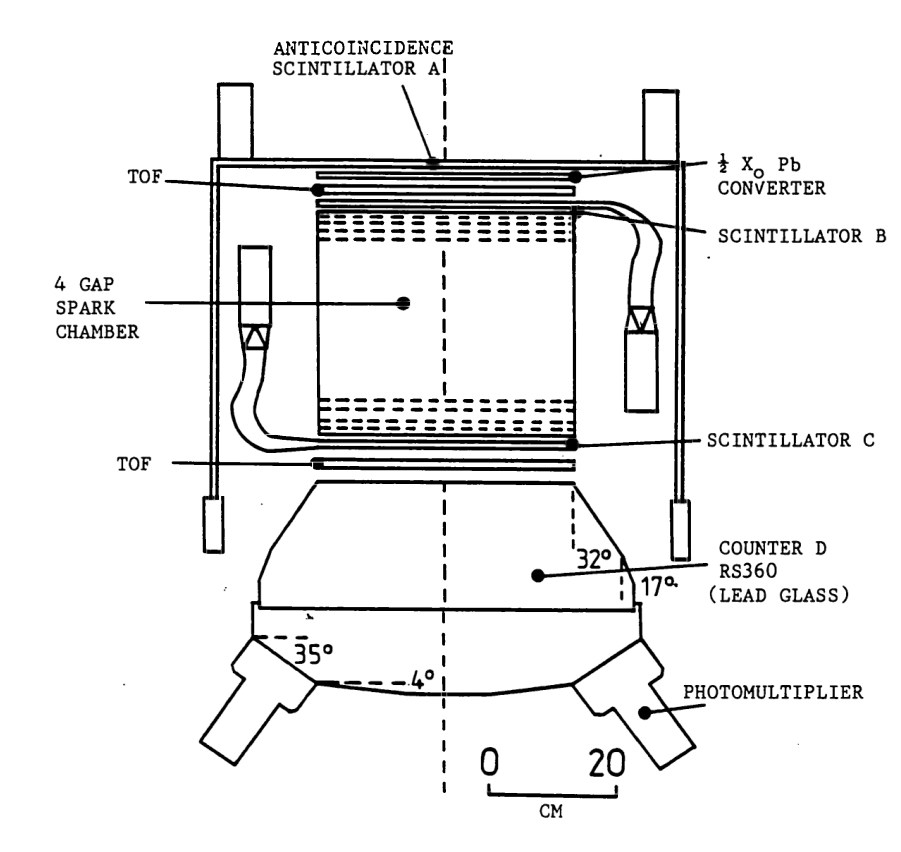
Objective of the flight was to detect Gamma Ray bursts with energies in the range of 50 KeV to 2 MeV using a gamma-ray telescope in a long duration balloon flight. The instrument developed by the Department of Physics of the Imperial College of Science and Technology in London was a pair-production instrument designed to investigate celestial gamma rays between 200 MeV and approximately 5 GeV.
The payload, which can be seen schematically in the image at left, integrated a lead pair-production converter, coincidence scintillation detectors, a time-of-flight system, a spark chamber, a lead-glass Cherenkov calorimeter, an anticoincidence shield, and a two-axis pointing system. The instrument was designed to combine high gamma-ray detection efficiency with effective rejection of charged-particle background while providing directional and energy measurements for individual gamma-ray events.
Gamma rays entered the telescope through a circular lead converter 19 cm in radius and one-half radiation length thick. Conversion of the incident photon into an electron-positron pair occurred within the lead, after which the secondary particles traversed the detector. The converter thickness was selected to balance pair-production efficiency against multiple scattering, which reduced directional accuracy and increased the probability that one member of the pair would leave the active detector volume before completing its trajectory.
Detection of the charged secondaries was performed by two circular coincidence counters designated B and C. Both detectors were manufactured from NE102A plastic scintillator with a radius of 19 cm. The upper scintillator was 6 mm thick and the lower scintillator 12 mm thick. Each detector was optically coupled through polished Perspex light guides to an EMI 6097A photomultiplier tube. Charge-sensitive electronics measured the pulse heights produced in both scintillators and temporarily stored the information until the event-selection circuitry validated the trigger. These measurements formed part of the event record transmitted to the ground and contributed to the identification of valid gamma-ray interactions.
Event selection required simultaneous responses from the coincidence scintillators, the Cherenkov calorimeter and the time-of-flight system together with the absence of any signal from the anticoincidence shield. Only events satisfying these conditions initiated spark chamber operation, minimizing detector dead time and reducing the number of non-astrophysical events recorded by the telemetry system.
The time-of-flight assembly discriminated between downward-moving gamma-ray events and upward-moving particles generated within the calorimeter by cosmic-ray interactions. It consisted of two NE104 plastic scintillators, each 20 cm in radius and 12 mm thick, positioned 50 cm apart. Two EMI 9810B photomultipliers viewed each scintillator through optical light guides. Fast leading-edge discriminators compared the arrival times of signals from the upper and lower detectors. The approximately 3 ns transit-time difference between upward- and downward-moving particles enabled the electronics to determine the direction of travel with an efficiency of about 90%, substantially reducing false triggers caused by backscattered secondary particles.
The calorimeter was constructed from Schott RS360 lead glass with a total depth of seven radiation lengths. Electromagnetic showers generated by the electron-positron pair produced Cherenkov radiation that was collected by six EMI 9530A photomultiplier tubes through Perspex light guides. The optical system was designed to maximize light collection from inclined particle showers by using polished reflecting surfaces while suppressing light produced by upward-moving particles through a roughened and blackened upper surface. Signals from the six photomultipliers were gain equalized, summed and processed by revised pulse-height electronics that extended the useful energy measurement range to approximately 5 GeV while maintaining a lower discrimination threshold of approximately 200 MeV. The increased dynamic range allowed measurement of higher-energy gamma rays without saturation of the calorimeter readout.
Particle tracking was provided by a four-gap spark chamber located between the lead converter and the calorimeter. The chamber contained a gas mixture of approximately 31% helium and 69% neon. Each gap consisted of two orthogonal planes of copper-beryllium wires separated by 1 cm. Following acceptance of a valid event, an 8 kV pulse was applied across the wire planes, producing sparks along the ionized paths of the electron and positron. Spark positions were determined using a magnetostrictive readout system in which stress waves generated at the fired wires propagated along Permendur sensing wires to pickup coils at both ends. Timing of the magnetostrictive pulses employed a crystal-controlled 4.2 MHz clock that improved the precision and stability of the position measurement. The reconstructed spark coordinates provided the trajectories of the secondary particles and permitted determination of the arrival direction of the incident gamma ray.
The detector was surrounded by an anticoincidence shield constructed from NE102A plastic scintillator to reject charged particles entering through the sides or top of the instrument. The shield comprised four cylindrical side panels measuring 51 cm in depth and 6 mm in thickness together with a circular upper detector 38 cm in radius and 9.5 mm thick. The side panels were viewed individually by EMI 9524A photomultipliers, while the upper detector employed two EMI 6097A photomultipliers. Detection of any charged particle by the shield vetoed the trigger before activation of the spark chamber, thereby suppressing the dominant component of the particle background.
Payload orientation was controlled by a two-axis pointing system capable of independent zenith and azimuth motion. The telescope could track predetermined celestial coordinates automatically or be directed manually through commands transmitted from the ground station. Continuous attitude measurements from the orientation sensors allowed reconstruction of the telescope axis throughout the flight and accurate association of every recorded gamma-ray event with its celestial direction.
The payload electronics comprised high-voltage power supplies, coincidence and veto logic, spark chamber control circuits, pulse-height analyzers, timing electronics, telemetry encoders and event formatting hardware. Spark chamber coordinates, calorimeter energy measurements, scintillator pulse heights, time-of-flight information and attitude data were combined into telemetry words for real-time transmission to the ground.
Details of the balloon flight
Balloon launched on: 11/13/1978
Launch site: Australian Balloon Launching Station, Alice Springs, Australia
Balloon launched by: ABLS Mildura
Balloon manufacturer/size/composition: Zero Pressure Balloon
End of flight (L for landing time, W for last contact, otherwise termination time): 11/15/1978
Balloon flight duration (F: time at float only, otherwise total flight time in d:days / h:hours or m:minutes - ): 58 h
The array was launched on a stratospheric balloon from Alice Springs, Australia on November 13 1978 and remained 58 hours aloft. Good data was obtained between 22:30 UTC 15 November 1978, and 21:30 UTC on 16 November 1978. After the flight the analysis of the data revealed the occurence of two burst events, at 22:14:12 on 15 November 1978, and at 13:40:2 on 16 November 1978.
External references
- Balloon-borne gamma ray astronomy and sources between 200 MeV and 5000 MeV Ph.D. Thesis by Hughes, J. B., Imperial College London, 1984
- Gamma ray observations in the energy range 0.3 J. Phys. E: Sci. Instrum. 15, 462 (1982)
- Gamma-ray burst measurements with a 6.3 sq M array Astrophysics and Space Science, vol. 77, no. 1, June 1981, p. 201
If you consider this website interesting or useful, you can help me to keep it up and running with a small donation to cover the operational costs. Just the equivalent of the price of a cup of coffee helps a lot.