
Purpose of the flight and payload description
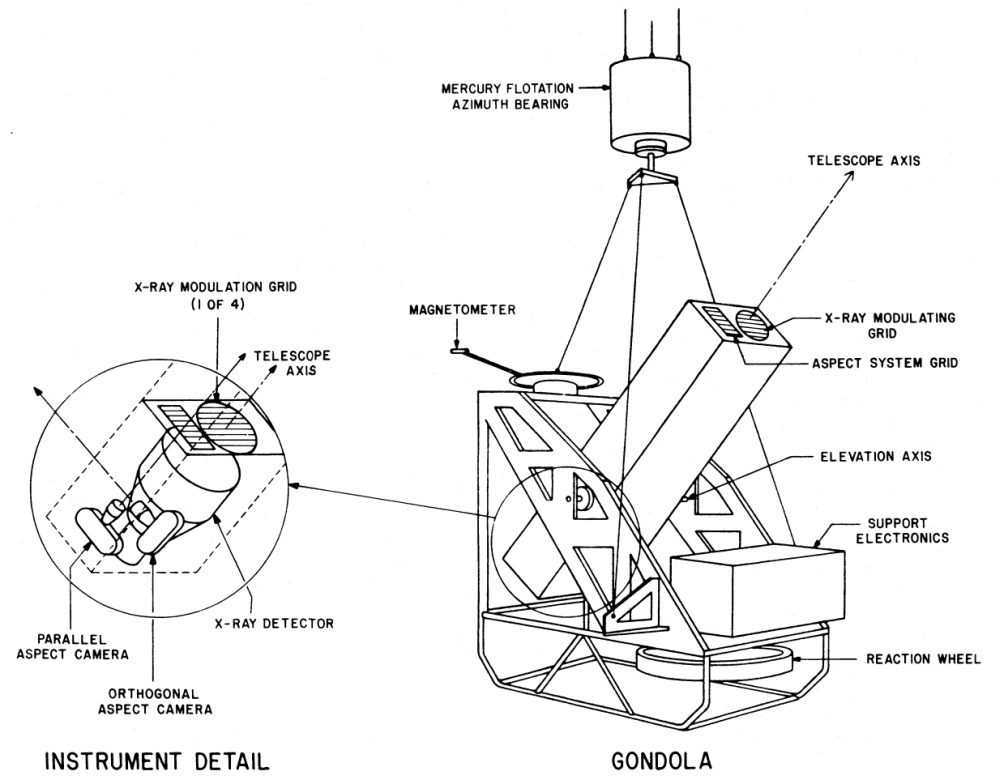
The objective of the balloon flight was to map the hard X-ray emission of the Crab Nebula between 22 and 63 keV, using an X-RAY TELESCOPE coupled with a MODULATION COLLIMATOR. Goal was to determine the two-dimensional structure of the high-energy source and its relation to the central pulsar. By scanning the nebula at multiple position angles, the researchers sought to understand the geometry, energy transport, and particle behavior within the nebula. The project had been a joint effort between the University of California, San Diego, and Japan's Institute of Space and Astronautical Science, supported by NASA, the U.S. National Science Foundation, the Japan Science Promotion Society, and Toyo Rayon Co.
The instrument can be seen schematically in the image at left (click to more details). It consisted of a multigrid modulation Collimator, a stellar aspect system, and a phoswich scintillation detector, all mounted within an alt-azimuth gimbal on a balloon gondola to ensure continuous source tracking with an accuracy of about 0.1°. The collimator itself had four grid layers, each with an area of roughly 580 cm², a transparency of about 48%, and a total thickness of 1.0 mm. Each layer was composed of ten 0.1 mm-thick photoetched invar sheets with a 300 µm mesh pitch, stacked together inside a 1.5 m-long, temperature-stable invar structure. Its angular response produced fan-beam transmission bands of 22 arcseconds full width at half maximum, repeating every 164 arcseconds. The alignment of the grids was adjusted to within about 5 µm using optical diffraction and X-ray shadowgraph methods, and their mechanical and thermal stability was carefully verified before flight.
The transmitted X-rays were detected by a 3 mm-thick, 25 cm-diameter cesium iodide (CsI(Na)) crystal, which was backed by a 12.5 cm-thick sodium iodide (NaI(Tl)) crystal. These two scintillators formed a phoswich configuration viewed by a single photomultiplier tube, allowing discrimination between background and valid aperture X-rays using pulse rise-time analysis. Each X-ray event was tagged with an eight-bit pulse height value spanning the 20230 keV range and a six-bit rise-time code, then transmitted to the ground with a 0.5 ms time resolution. The detector viewed the collimator through a precollimator with a 5.5° × 5.5° field.
The instrument also incorporated two 16 mm cameras for determining its orientation by photographing stellar fields, one aligned with the collimator's viewing direction and another perpendicular to it. These cameras used 135 mm, f/2 lenses, covering about 4° × 3° of the sky, and employed Kodak 2X film with a limiting magnitude of 78 in one-second exposures. Each exposure was time-stamped with better than 0.1 s precision using an internal optical time code. The relative alignment between the collimator and cameras was maintained to within 5 arcseconds using an optical fiducial system. A servo magnetometer provided high-frequency monitoring of the telescope's motion to complement the slower photographic sampling.
During operation, the source was scanned linearly along the telescope's pitch axis as a result of residual motion between the collimator beam and the source, and many such scans were combined to form a single effective scan at each position angle. Because the alt-azimuth mounting caused continuous rotation of the scan direction during observation, multiple scans at different angles could be combined to reconstruct a complete two-dimensional image. The telescope's angular precision goal of about 10 arcseconds was met through careful aspect recovery and alignment calibration.
This combination of precision Collimation, phoswich detection, and optical aspect control allowed the telescope to achieve 15-arcsecond angular resolution in the 2264 keV energy range.
Details of the balloon flight
Balloon launched on: 2/28/1977
Launch site: National Scientific Balloon Facility (NSBF), Palestine, Texas, US
Balloon launched by: National Scientific Balloon Facility (NSBF)
Balloon manufacturer/size/composition: Zero Pressure Balloon Winzen - 580.498 m3 (12.70 microns)
Flight identification number: 1007P
End of flight (L for landing time, W for last contact, otherwise termination time): 2/28/1977
Balloon flight duration (F: time at float only, otherwise total flight time in d:days / h:hours or m:minutes - ): F 4 h 30 m
Payload weight: 1038 kgs
External references
- A scanning modulation collimator observation of the high-energy X-ray source in the Crab Nebula Astrophysical Journal, Part 1, vol. 319, Aug. 1, 1987, p. 416
- Hard X-ray structure of the Crab Nebula Space Science Reviews, vol. 30, no. 1-4, 1981, p. 259-262
- Hard X-ray Structure of the Crab Nebula [in Japanese] Bulletin of the Institute of Space and Aeronautical Science, University of Tokyo 16(2_B), 1033-1049, 1980-07
- National Scientific Balloon Facility Annual Report, FY 1977 National Center for Atmospheric Research, 1978
If you consider this website interesting or useful, you can help me to keep it up and running with a small donation to cover the operational costs. Just the equivalent of the price of a cup of coffee helps a lot.