
Purpose of the flight and payload description
CRISIS was the acronym for Cosmic Ray Isotope Separation Instrumentation System an experiment aimed to measure the elemental and isotopic composition of cosmic ray nuclei with charges greater than or equal to 10, with particular emphasis on resolving isotopes in the silicon to nickel range. The goal was to obtain accurate mass and charge measurements of these relatively rare nuclei to investigate their origins, propagation, and any deviations from solar system abundances, which could reveal details about nucleosynthesis and acceleration processes in astrophysical environments. This effort aimed to improve understanding of cosmic ray sources, particularly the conditions under which heavy nuclei are synthesized and accelerated in the galaxy was arried out at the School of Physics and Astronomy at the University of Minnesota.
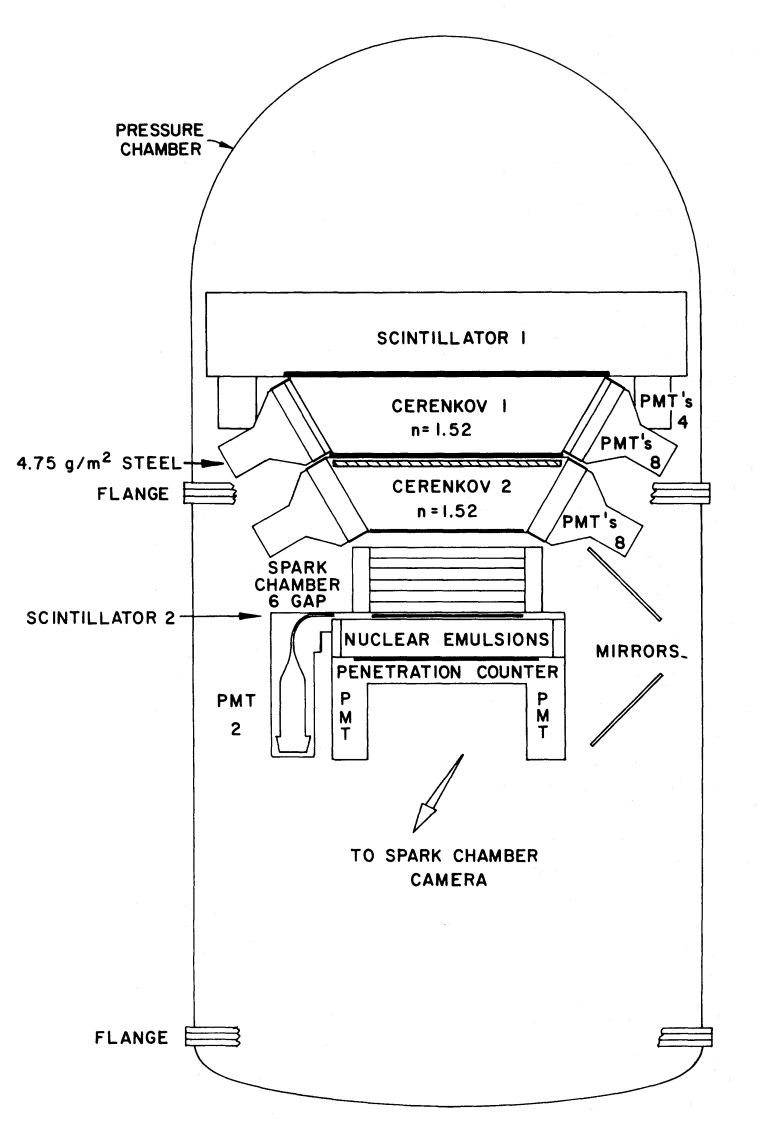
In the image at left we can see a basic scheme of CRISIS. The insrument was structured as a vertically oriented stack with multiple detection layers, each contributing specific measurements necessary for accurate identification and analysis of cosmic ray particles. At the top of the instrument, the first layer consisted of a large plastic scintillator labeled S1, which served as the primary trigger for incoming particles and provided initial charge measurements. The S1 scintillator was viewed by photomultiplier tubes (PMTs), specifically 5-inch RCA 4525 PMTs, which converted light flashes into electronic signals. Immediately beneath S1 was the first Cerenkov radiator, C1, made of Pilot 425 plastic with an index of refraction tuned for threshold Cerenkov light production by relativistic heavy ions. This combination of S1 and C1 provided a high-quality charge determination with minimal interference from knock-on electrons, as S1 was placed at the very top with little material above it.
Following C1, the next key component was the spark chamber, which recorded the two-dimensional trajectory of each detected particle. The chamber incorporated multiple spark gaps and was equipped with eight fiducial lamps in both the front and side views, which ensured a positional repeatability within ±2.5 microns. The spark chamber fired in coincidence with suitable trigger conditions from S1 and S2, ensuring efficient recording of the trajectory for particles that could be traced precisely through the detector.
Below the spark chamber was S2, the second scintillator and C2, the second Cerenkov radiator. S2, like S1, was made of plastic scintillator material but was viewed by smaller 2-inch EMI 9656R PMTs. C2 provided a secondary, independent Cerenkov measurement. Both S2 and C2 served multiple purposes: they verified charge consistency, identified possible interactions above the emulsion stack, and provided an additional cross-check for charge and velocity determinations.
Beneath the C2 detector lay a block of nuclear emulsions, which served as the range detector. The emulsion stack allowed precise measurement of the residual range of stopping particles, which was critical for mass determination. Each emulsion was carefully weighed and measured before flight, and post-flight calibrations determined an average density of 3.87 g/cm³. Variations in emulsion thickness and area were meticulously corrected during data reduction. The emulsion provided spatial resolution necessary for range calculations and helped distinguish particles that stopped in the instrument from those that penetrated further.
At the very bottom, a penetration scintillator labeled Sp completed the detection system. This scintillator served as a veto counter: any particle generating a signal in Sp was considered to have penetrated the emulsion block and thus was excluded from the sample of stopping particles eligible for mass analysis.
The electronic system included discriminators, coincidence logic, and data acquisition hardware. Trigger logic was configured to favor the rare heavy nuclei, dynamically adjusting the sampling fractions during flight via command uplinks. The discriminator levels were set on S1 and S2 to preferentially trigger on high-Z, fast nuclei, effectively filtering out the more common low-Z species like oxygen. Data acquisition was fully digital, recording pulse height information from all photomultiplier tubes onto magnetic tapes, alongside high-resolution 35-mm film records of the spark chamber events.
All detection components were housed inside a pressurized and thermally insulated aluminum gondola shell with a thickness equivalent to 0.67 g/cm² of aluminum. This minimized atmospheric contamination and shielded the detectors from thermal fluctuations.
Details of the balloon flight
Balloon launched on: 5/20/1977
Launch site: Aberdeen, South Dakota, US
Balloon launched by: National Scientific Balloon Facility (NSBF)
Balloon manufacturer/size/composition: Zero Pressure Balloon Winzen 937.906 m3 (12.70 Microns)
Flight identification number: 132N
End of flight (L for landing time, W for last contact, otherwise termination time): 5/21/1977
Balloon flight duration (F: time at float only, otherwise total flight time in d:days / h:hours or m:minutes - ): F 56 h 42 m
Landing site: In the state of Washington, US
Payload weight: 1220 kgs
The balloon carrying CRISIS was launched by the National Scientific Balloon Facility from Aberdeen, South Dakota on May 20, 1977. The balloon carried the instrument to the upper atmosphere, where it floated at an altitude corresponding to a mean residual atmospheric depth of 2.6 grams per square centimeter. The total duration of the flight was 56 hours and 41 minutes. The balloon flight occurred during an exceptionally quiet period of solar activity, specifically between May 19 and May 22, 1977. This period had been classified as "superquiet" by other researchers, indicating that the fluxes of low-energy solar particles were at their lowest levels ever recorded, which minimized contamination from solar events and allowed for cleaner measurements of galactic cosmic rays.
The data collection during the flight was continuous and efficient producing a total of thirteen data tapes containing electronic data and 27,015 spark chamber photographs. Additionally, the nuclear emulsion block served as a physical record of stopping events for post-flight laboratory analysis. The combination of long flight duration, stable atmospheric conditions, low solar activity, and effective event selection mechanisms resulted in a rich dataset, enabling detailed studies of cosmic ray isotopic compositions after recovery.
External references
- Launching CRISIS - A scientific balloon launch from the center of the continent Thor Olson's website
- Detection of the Isotopes of Heavy Cosmic Ray Nuclei Proceedings from the 14th International Cosmic Ray Conference, Germany, 1975. Volume 9, p.3166
- National Scientific Balloon Facility Annual Report, FY 1977 National Center for Atmospheric Research, 1978
- Some Isotopic Abundances in the Cosmic Radiation 16th International Cosmic Ray Conference, Vol.1 P.442, 1979
- The Charge Distribution of Heavy Cosmic Ray Nuclei 16th International Cosmic Ray Conference, Vol. 1.
- The elemental and isotopic composition of cosmic rays - Silicon to nickel Astrophysical Journal, Part 1, vol. 246, June 15, 1981, p. 1014-1030
- The neutron-rich isotopes of cosmic-ray neon and magnesium Astrophysical Journal, Part 2 - Letters to the Editor, vol. 240, Aug. 15, 1980, p. L53
Images of the mission


If you consider this website interesting or useful, you can help me to keep it up and running with a small donation to cover the operational costs. Just the equivalent of the price of a cup of coffee helps a lot.