
Purpose of the flight and payload description
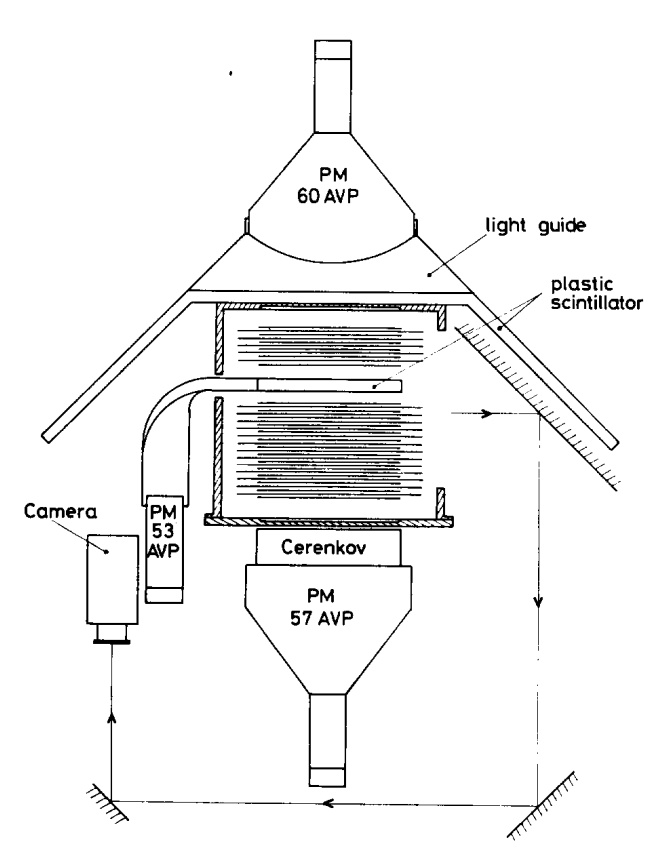
The JUSTINE GAMMA-RAY TELESCOPE was a balloon-borne instrument aimed to detect and measure gamma rays from discrete astrophysical sources in the energy range from 100 MeV to 1 GeV, which would provide crucial information about high-energy electrons and protons in cosmic environments. The experiment was developed by the Groupe de Recherche Associé au CNRS Centre d'Études Spatiales des Rayonnements at Toulouse, France, and the Observatoire de Toulouse.
In the image at left we can see a scheme of the telescope. The core detection assembly consisted of a spark chamber associated with three detection elements: two scintillation counters designated A and B, and a Cherenkov counter C. Counters B and C functioned as a telescope configuration that commanded the triggering of the spark chamber, while the large-surface detector A operated in anticoincidence mode to eliminate charged particles from the detection process. Detector A incorporated an SPF scintillator with an area of 8000 square centimeters and a thickness of 1.5 centimeters, coupled with a 60 AVP photomultiplier through a lucite light pipe, achieving an efficiency greater than 99.9%. Detector B consisted of a plastic scintillator with a 20-centimeter diameter paired with a 53 AVP photomultiplier, while the Cherenkov counter featured a lucite radiator of 20-centimeter diameter and 5-centimeter thickness connected to a 57 AVP photomultiplier.
The fast electronics circuit controlled the high-voltage triggering system for the spark chamber with precise timing characteristics. Pulses from the photomultiplier anodes were directed to a fast coincidence-anticoincidence circuit after shaping and selection by discriminators, with the entire system maintaining a time resolution of 20 nanoseconds. The output pulses from the coincidence circuit commanded both the high-voltage pulse generator and a dead time generator that blocked the coincidence circuit for approximately half a second after particle passage, allowing time for capacitor charging and camera advancement.
The high-voltage pulse generator was strategically positioned on a lateral wall of the chamber to minimize connection lengths and ensure rapid pulse delivery. A DC-DC converter provided adjustable high voltage ranging from 6 to 10 kilovolts, with the pulse generator responding to coincidence pulses through a system incorporating an avalanche transistor, a thyristor, and a pulse transformer (TR 148 Edgerton) that delivered a 5-kilovolt pulse to the trigger electrode of a spark gap TG 179 manufactured by Signalite.
The spark chamber itself featured a parallelepiped enclosure constructed from aluminum alloy, with hard glass portholes equipped with field lenses that enabled stereoscopic imaging of the entire sensitive volume. The electrodes were staggered and separated by crosspieces that maintained an interplate interval of 5 millimeters. The chamber contained 28 duralumin plates, each with an effective surface area of 20 by 20 centimeters. The configuration utilized the first five plates, each 1 millimeter thick, as anticoincidence detectors for charged particles. The following ten plates, 3 millimeters thick, served as conversion targets for gamma-ray pair production processes. The remaining plates, positioned below the plastic scintillator B, enabled definition of electron trajectories within the detection volume.
The photographic recording system employed a modified Beaulieu R16 Electric camera that operated without a shutter in single-frame mode. The objective lens functioned at f/2.8, and the magazine accommodated 60 meters of 2X Kodak film. The system captured two perpendicular views of the chamber at 90 degrees, juxtaposing these images on 16-millimeter film. Simultaneously, the camera photographed coordinate axes, a watch, a compass dial, and various list indicators, with these instruments illuminated by lamps triggered after spark formation. The camera triggering system activated lamp illumination following spark detection, then initiated the camera motor, with stopping controlled by cam contact when the film advanced by one frame.
The assembly included also a slow coincidence system between pulses from the dynodes of photomultipliers A, B, and C, enabling counting of charged particles and verification of detector proper operation. A DC-DC converter supplied all necessary operating voltages from a single battery source. The batteries utilized cadmium-nickel elements that performed excellently under cold or vacuum conditions.
Additional systems included a commutator for transmitting various voltages and temperature references, and an atmospheric density measurement system that provided balloon altitude information through current measurement in an ionization chamber called an alphatron. The orientation control system maintained constant heading through a prism with two reflective surfaces fixed to a graduated and moving compass component. The position detection system, located outside the compass and interconnected with the platform, included a luminous source followed by convergent optics that focused a light beam on the prism edge. This beam divided into two reflected beams that, after passing through a convergent lens, formed an image of the luminous spot on photoresistant cells. When compass variations occurred, intensity differences between the two cells triggered a servomechanism with an associated motor that restored equilibrium position and maintained fixed directional orientation for the 180-kilogram platform.
Details of the balloon flight
Balloon launched on: 3/22/1973 at 03:04
Launch site: National Institute of Space Research, Sao Jose dos Campos, Sao Paulo, Brazil
Balloon launched by: Centre National d'Etudes Spatiales (CNES)
Balloon manufacturer/size/composition: Zero Pressure Balloon 84.000 m3
End of flight (L for landing time, W for last contact, otherwise termination time): 3/22/1973 at L+11
Balloon flight duration (F: time at float only, otherwise total flight time in d:days / h:hours or m:minutes - ): 11 h
Landing site: In Rolandia - Paraná
Payload weight: 304.4 kg
External references
- A infraestrutura do INPE para lancar balao cientifico Elisete Rinke dos Santos, editorial Transtec, 1993
- Chambre à Étincelles Optique pour la Recherche de Sources de Rayons Gamma New techniques in Space Astronomy. IAU Symposium no. 41, held in Munich, Aug. 10-14, 1970, Pag. 79
- Diffuse Cosmic Gamma-Ray Background Above 20 MeV 13th International Conference on Cosmic Rays, Volume 1, p.8
- Diffuse gamma ray measurement above 20 MeV with a balloon borne experiment International cosmic ray conference; Garching, near Muenchen, F.R. Germany; 15 Aug 1975
- High energy gamma-ray emission from the region of the galactic center Astrophysics and Space Science, 47(2), 401
If you consider this website interesting or useful, you can help me to keep it up and running with a small donation to cover the operational costs. Just the equivalent of the price of a cup of coffee helps a lot.