Purpose of the flight and payload description
The instrument was a HIGH ENERGY NUCLEI TELESCOPE designed to measure the charge composition and energy spectra of cosmic-ray nuclei with atomic charge Z = 3 at energies above 20 GeV per nucleon. Its primary goal was to improve the statistical and systematic resolution of previous measurements, and to provide more precise data in the high-energy region, particularly to explore whether secondary nuclei -those produced by spallation- showed a decreasing abundance relative to primary nuclei as energy increased. The experiment was built at the Enrico Fermi Institute and the Department of Physics, Laboratory for Astrophysics and Space Research at the University of Chicago and partially funded by a NASA grant and flown for the first time over Texas in Fall 1971.
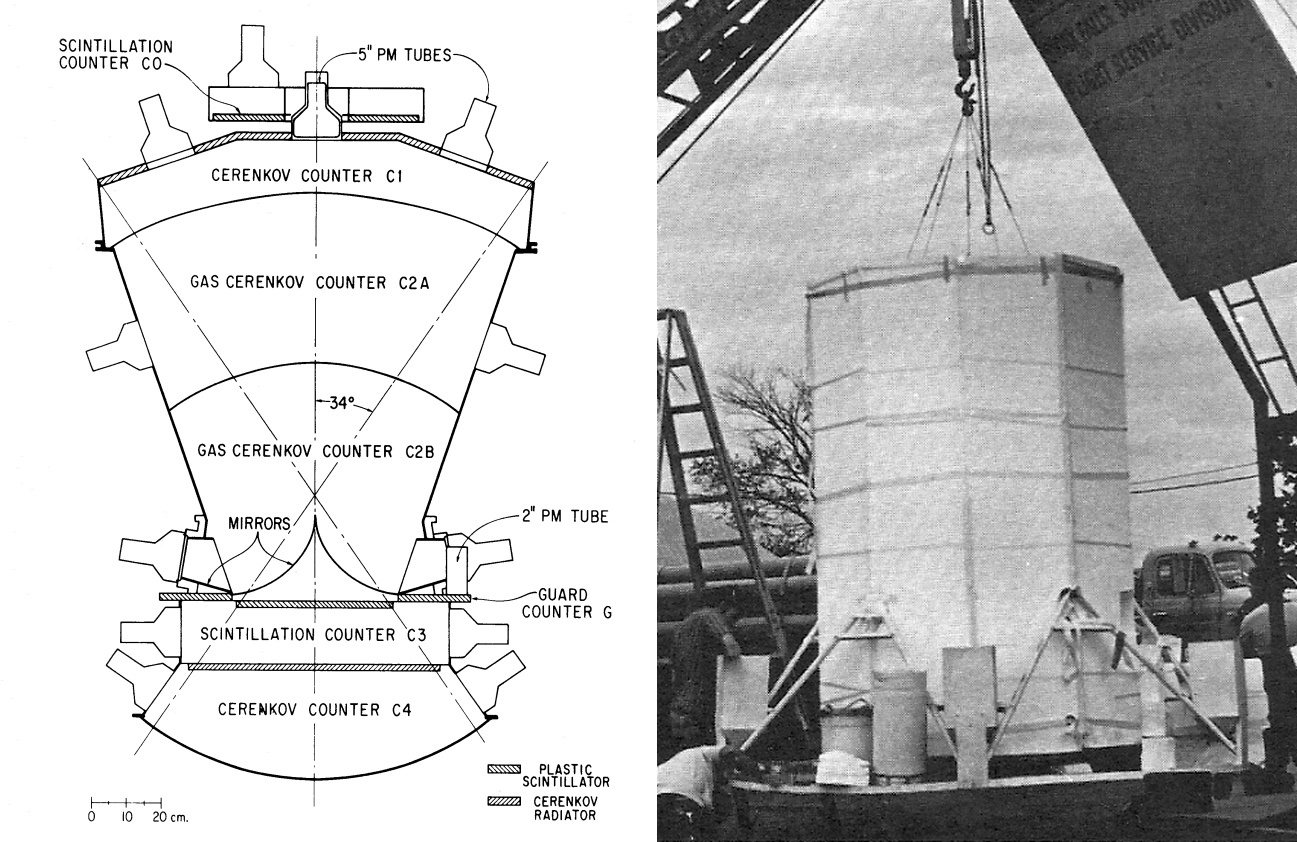
In the image at left we can see an scheme of the instrument and a picture of the gondola before a flight (click to enlarge). During this second series of flights performed in 1972 from Missouri, changes were made to the material composition and roles of the three main counters to enhance low-energy resolution without compromising high-energy capabilities, thereby improving the statistical precision and elemental discrimination of the measurements across all energy bands. Cl and C4, which had originally been plastic Cerenkov counters, were replaced with scintillation counters constructed from Pilot Y and made 11 mm thick. Conversely, C3, originally a scintillator, was replaced with a 22-mm-thick Cerenkov counter made from Pilot 425. This inversion in detector types was intended primarily to improve resolution at low energies (below a few GeV per nucleon), although it did not significantly affected the high-energy measurements that were the focus of the mission. The geometric factor of the instrument in version II, determined using the coincidence between Cl, C4, and the guard counter G, increased slightly to 950 cm²·sr.
The gas Cerenkov counters, C2A and C2B, continued to be employed for energy measurements above 20 GeV per nucleon, but their specific usage and gas fill were adjusted across the subsequent flights. In version II, C2B became the primary focusing counter and was filled with freon-12 in both 1972 flights to maintain a low energy threshold for detection. The second gas used in each flight to provide a lower refractive index, and hence a higher energy threshold, was also varied: CO2 was used in flight 2, resulting in a threshold energy of 31 GeV per nucleon; in flight 3, a mixture of SF6 and methane was employed, lowering the threshold to 24 GeV per nucleon. The upper counter, C2A, which had used freon-12 in version I, was excluded from version II except during the final third of flight 2, when it malfunctioned and had to be disregarded for data analysis. These modifications allowed energy resolution to remain high across the 20100 GeV per nucleon range, while the gas choices allowed variation in the range and sensitivity of the measurements. The guard counter G and the small counter CO remained part of the design and continued to serve the same functions as in the original configuration.
As occured in the first flight, data was recorded on an on-board tape, as well as being transmitted to a University of Chicago telemetry station.
The experiment was tightly fitted into an aluminum capsule with all power supplies contained in exterior mounted boxes. An awkward framework consisting of five support struts with a 10 foot circular base provided the attachment points for five ballast hoppers, control instrumentation, timers, batteries, and crush pad.
Details of the balloon flight

Balloon launched on: 9/28/1972 at 7:41 UTC
Launch site: Cape Girardeau Municipal Airport, Missouri, US
Balloon launched by: Raven Industries Inc.
Balloon manufacturer/size/composition: Zero Pressure Balloon Winzen 15.000.000 cuft Natural Shape (0.7 mils.) 2 Caps. (0.7 Mils) Stratofilm
Balloon serial number: SN:34
Flight identification number: Raven Nº 1340
End of flight (L for landing time, W for last contact, otherwise termination time): 9/29/1972 at 22:45 UTC
Balloon flight duration (F: time at float only, otherwise total flight time in d:days / h:hours or m:minutes - ): 39 h 10 m
Landing site: Near Coshocton, Ohio, US
Campaign: SKYHOOK 72
Payload weight: 2798 lbs.
The balloon was launched from the Cape Girardeau airport in Missouri at 7:41 UTC on September 28, 1972. The launch conditions were very good with the wind steady at five mph, however, at the time of launch the wind was 90º to the layout which caused the launch to be something other than routine. As the balloon was released, it drifted off to the west instead of south toward the launch vehicle. The crane was moved south to the first intersection of the runway than turned west, chasing the balloon, which was leaning at 60º. As the crane accelerated to its maximum speed of twenty mph, the gondola was fired loose from the crane, resulting in a smooth launch. Four hours and twenty minutes later the flight leveled off at 4.45 mbs (121,400 feet).
The flight was scheduled to be aloft for 63 hours, however program management and the Office of Naval Research Field Representative decided it was best to terminate the flight after about 40 hours since it was moving out of range and it would have had to continue through the night without ballast. Forecast trajectory would have placed the flight over the Washington, D.C. area by the following morning.
The Tracking C-47 terminated the flight east of Coshocton, Ohio. Recovery was performed with the gondola being taken by truck, direct to the University's lab in Chicago.
External references
- Flight Summary of balloons made of Stratofilm - 1971 to 1972, Technical report, Winzen Research International. Circa 1973 - Stratocat's private collection
- Skyhook Churchill 1972 Interim Report, Raven Industries, 1973
If you consider this website interesting or useful, you can help me to keep it up and running with a small donation to cover the operational costs. Just the equivalent of the price of a cup of coffee helps a lot.