
Purpose of the flight and payload description
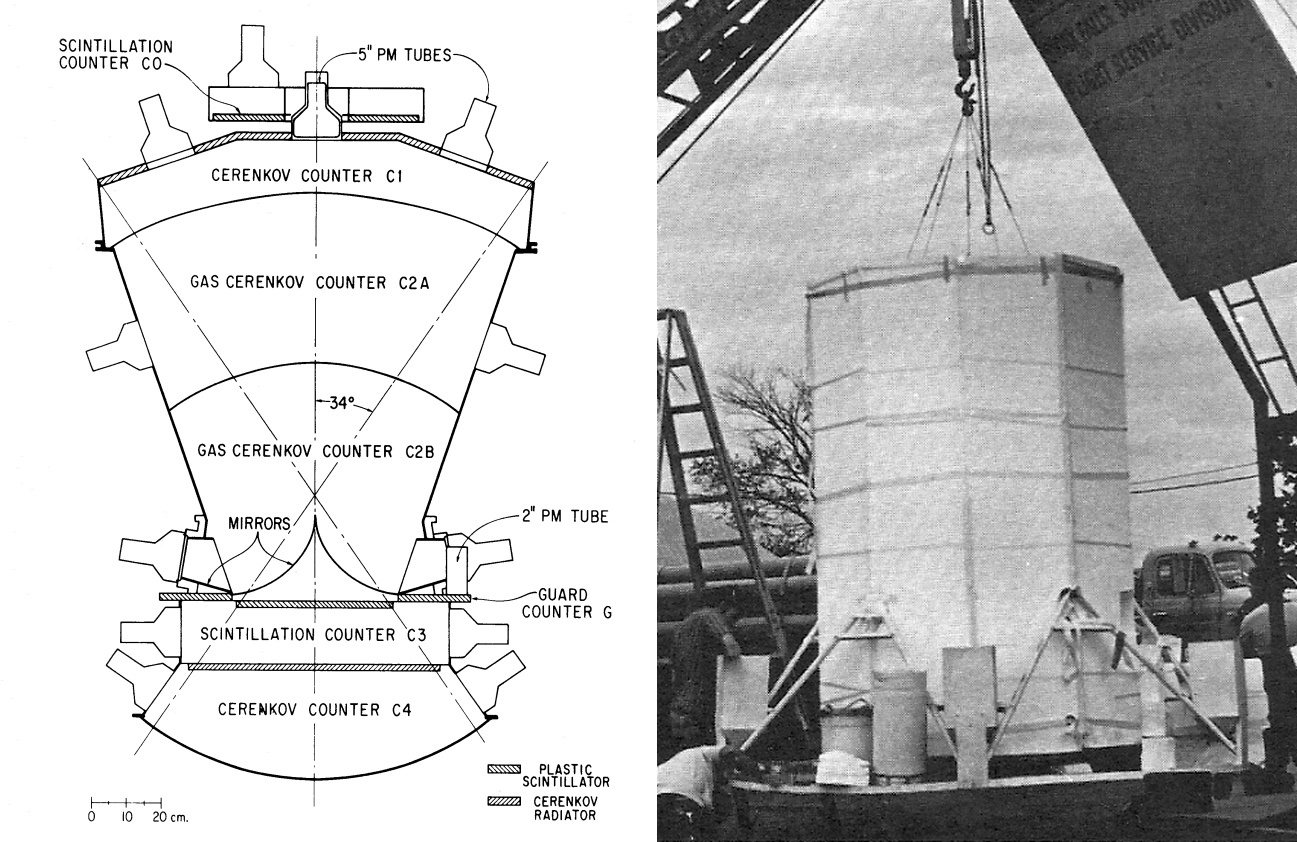
The instrument was a HIGH ENERGY NUCLEI TELESCOPE designed to measure the charge composition and energy spectra of cosmic-ray nuclei with atomic charge Z = 3 at energies above 20 GeV per nucleon. Its primary goal was to improve the statistical and systematic resolution of previous measurements, and to provide more precise data in the high-energy region, particularly to explore whether secondary nuclei -those produced by spallation- showed a decreasing abundance relative to primary nuclei as energy increased. The experiment was built at the Enrico Fermi Institute and the Department of Physics, Laboratory for Astrophysics and Space Research at the University of Chicago and partially funded by a NASA grant.
In the image at left we can see an scheme of the instrumnet and a picture of the gondola before a flight (click to enlarge). The configuration of the instrument used in this flight consisted of a layered telescope structure that incorporated three plastic counters designated Cl, C3, and C4. Of these, Cl and C4 were Cerenkov counters constructed from Pilot 425 plastic material, with respective thicknesses of 10 mm for Cl and 5 mm for C4. The third counter, C3, was a scintillation counter made from Pilot Y, also 5 mm thick. These three counters functioned together to determine both the energy and the charge of each cosmic-ray nucleus passing through the instrument over an energy range extending from 0.33 GeV per nucleon up to several GeV per nucleon. All counters were enclosed in light-integration boxes internally lined with a highly reflective white material (approximately 97% reflectivity) to ensure maximum light collection and achieve high measurement uniformity. To improve the charge resolution, particularly for heavier nuclei such as iron, the Cl counter was segmented into six parts. Each segment was oriented perpendicularly to the line connecting the segment's center to the center of C3. This segmentation helped to reduce the spread in path length through Cl, enhancing the charge resolution. The geometric factor for this version of the instrument, determined by the coincidence detection between Cl and C3, was 850 cm²·sr.
Additionally, the instrument housed two gas Cerenkov counters, C2A and C2B, for high-energy measurements above 20 GeV per nucleon. These counters exploited the dependence of Cerenkov light output on the nucleus's velocity, providing a way to estimate energy. C2A was a white counter employing the light integration method, while C2B was a focusing counter that used mirrors to direct Cerenkov photons into photomultiplier tubes. C2B had the advantage of being less sensitive to random noise and gas scintillation, whereas C2A offered better intrinsic resolution, limited primarily by photoelectron statistics. Freon-12 was used as the working gas in C2A during this flight to increase the refractive index, which lowered the energy threshold to approximately 19 GeV per nucleon. Air was used in C2B, resulting in a higher threshold of about 40 GeV per nucleon. The instrument also included a guard counter labeled G, positioned to reject background signals caused by charged particles not passing through the telescope aperture. A small counter, CO, was available to restrict the telescope's opening angle when necessary.
Data was recorded on an on-board tape, as well as being transmitted to a University of Chicago telemetry station.
All these elements were tightly fitted into an aluminum capsule with all power supplies contained in exterior mounted boxes. An awkward framework consisting of five support struts with a 10 foot circular base provided the attachment points for five ballast hoppers, control instrumentation, timers, batteries, and crush pad.
Details of the balloon flight
Balloon launched on: 9/28/1971 at 19:04 CDT
Launch site: NCAR National Scientific Balloon Flight Station, Palestine, Texas, US
Balloon launched by: NCAR National Scientific Balloon Flight Station
Balloon manufacturer/size/composition: Zero Pressure Balloon Winzen 15.000.000 cuft (0.7 Mil. 2 x Caps. 0.7 Mil. Stratofilm)
Balloon serial number: SF 334.85-070-NSC-01 Serial Nº 21
Flight identification number: 636P
End of flight (L for landing time, W for last contact, otherwise termination time): 9/29/1971
Balloon flight duration (F: time at float only, otherwise total flight time in d:days / h:hours or m:minutes - ): F 29 h 10 m
Landing site: In Del Rio, Texas, US
Payload weight: 3204 lbs.
The balloon was launched from the NCAR Scientific Flight Station in Palestine, Texas at 19:04 CDT on September 28, 1971. After a nominal ascent phase the balloon reached a float altitude of 3.93 millibars and remained in flight for almost 30 hours. Initially the flight was planned to remain aloft for 72 hpurs but it was terminated earlier due to the fact that it approached to Mexico.
External references
- Composition of Cosmic-Ray Nuclei at High Energies Phys. Rev. Lett. 29, 1288 (1972)
- Composition of Cosmic-Ray Nuclei at High Energies Phys. Rev. Lett. 29, 445 (1972)
- NCAR Scientific Balloon Facility Annual Report, 1971 National Center for Atmospheric Research, February 1972
- Review of Recent Performance of Large Balloons and Balloons with Payloads in Excess of 3000 Pounds Proceedings, Seventh AFCRL Scientific Balloon Symposium, 1973
If you consider this website interesting or useful, you can help me to keep it up and running with a small donation to cover the operational costs. Just the equivalent of the price of a cup of coffee helps a lot.