
Purpose of the flight and payload description
This balloon flight was part of a broader program conducted to obtain simultaneous measurements of atmospheric electric fields from multiple locations across the Canadian subauroral, auroral, and polar regions. Balloons were launched from Cambridge Bay, Churchill, Yellowknife, Uranium City, McMurray, and Penhold, in groups of six providing observations over magnetic latitudes extending from near the plasmapause to the polar cap. The primary objective was to measure large-scale ionospheric electric fields and use them to infer magnetospheric electric fields, while distinguishing spatial variations from temporal changes through simultaneous observations at multiple sites. The experiment also sought to determine how magnetospheric electric fields varied with latitude, local time, and geomagnetic activity, and to investigate their role in plasma convection and geomagnetic disturbances such as magnetic bays and substorms. The program was carried out by scientists from the Physics Department and Space Sciences Laboratory of the University of California, Berkeley.
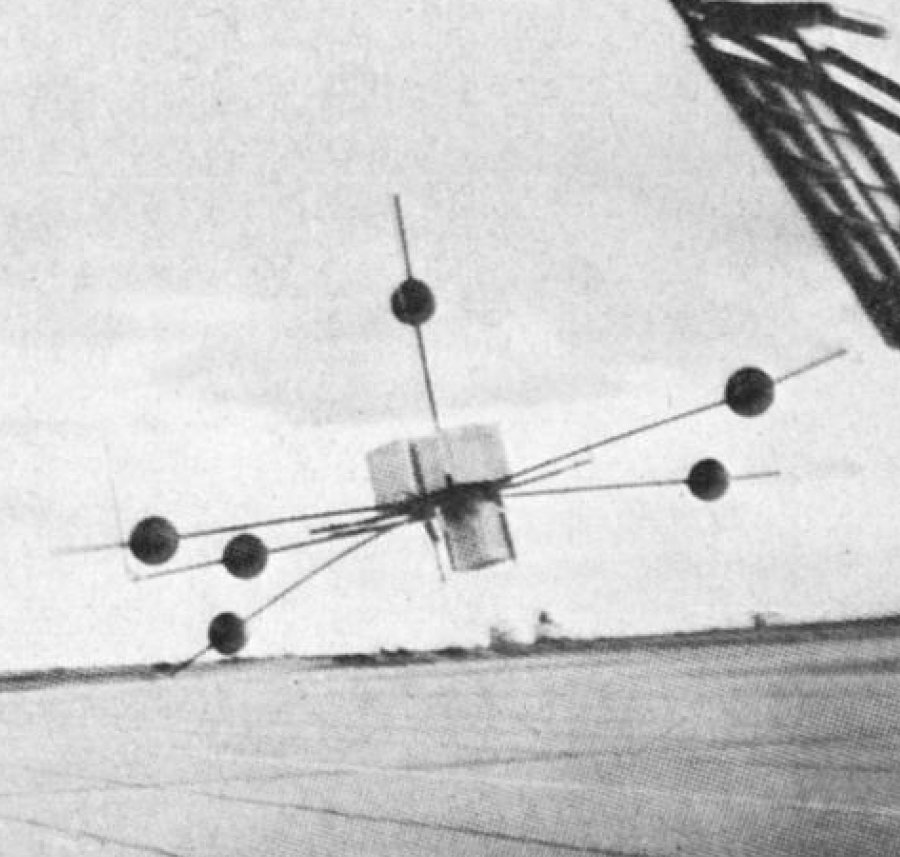
The image at left shows one of the payloads immediately after launch. The electric-field instrument consisted of three mutually orthogonal pairs of conductive spheres mounted on insulating booms approximately three meters long. Each pair formed an electric-field antenna aligned along one of three perpendicular axes. The spheres were connected to high-input-impedance differential voltmeters that measured the potential difference between opposite spheres. Electric-field strength along each axis was determined by dividing the measured potential difference by the separation distance between the spheres. This configuration allowed simultaneous measurement of three orthogonal components of the ambient electric field. An onboard magnetometer provided orientation data, allowing the horizontal electric-field measurements to be resolved into magnetic northward and eastward components. The payload was suspended approximately 50 yards below the balloon to reduce distortion of the electric field by the balloon.
A principal design requirement was the separation of large vertical electric fields generated by atmospheric weather processes from weaker horizontal fields associated with ionospheric and magnetospheric processes. To accomplish this, the payload incorporated a leveling system based on a carpenters level sensor that continuously monitored orientation relative to the vertical. The system maintained the horizontal antennas within approximately 0.5° of horizontal, reducing contamination of the horizontal measurements by the vertical atmospheric electric field. The payload also rotated at an average rate of about six revolutions per hour. As a result, a horizontal external electric field appeared as an alternating signal at the rotation frequency, while residual contributions from the vertical electric field appeared primarily as a direct-current offset.
The design also addressed contact-potential effects between sensor spheres. Small differences in surface work function could produce voltage offsets equivalent to electric fields of several millivolts per meter. To minimize this effect, the spheres were coated with carbon to produce nearly identical surface properties. The instrument used ultra-high-input-impedance electronics to ensure accurate electric-field measurements throughout the flight altitude range.
An additional subsystem measured atmospheric conductivity during flight. Every 256 seconds, antenna elements were momentarily shorted together. After the short was removed, the recovery time constant was measured. Atmospheric conductivity was then calculated from the recovery time and the dielectric constant of free space. These measurements provided conductivity profiles as a function of altitude during ascent and supported analysis of electric-field propagation between the ionosphere and balloon altitude.
The telemetry system used four FM-FM subcarrier channels. Three channels continuously transmitted the measured electric-field components. The fourth channel transmitted multiplexed data from a commutator system, including additional electric-field sensitivity ranges, magnetometer measurements, horizontal-orientation data, and housekeeping parameters such as temperatures, voltages, and currents.
Details of the balloon flight
Balloon launched on: 8/2/1969
Launch site: Yellowknife, Northwestern Territories, Canada
Balloon manufacturer/size/composition: Zero Pressure Balloon
End of flight (L for landing time, W for last contact, otherwise termination time): 8/3/1969
External references
- Magnetospheric electric field properties deduced from simultaneous balloon flights J. Geophys. Res., 76(7), 16971712
If you consider this website interesting or useful, you can help me to keep it up and running with a small donation to cover the operational costs. Just the equivalent of the price of a cup of coffee helps a lot.