
Purpose of the flight and payload description
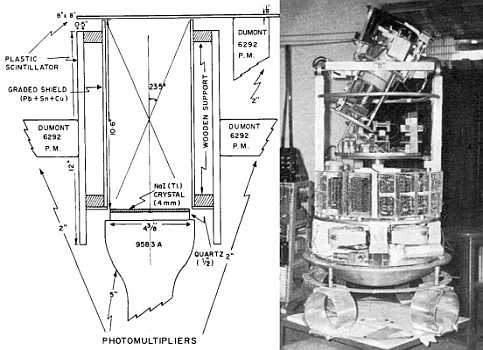
The X-ray telescope consisted on a NaI (TI) crystal of effective area 97 cm3 and thickness 4 mm optically coupled to a 5 inches of diameter photomultiplier tube. The crystal was surrounded by both active and passíve collimators. The passive Collimator was composed of a cylindrical graded shield of lead, tin and copper and the active collimator was a cylindrical plastic scintillator viewed by two 2 inches of diameter phototubes. A schematic diagram is shown at left. The pulses from the NaI crystal were sorted into fifteen continuous channels. All the information was recorded in a continuously moving photographíc film. An Am241 source came into the field of view of the telescope periodically and provided in-flight calibration of the detector at 16.5 and 59.4 keV during the entire period of the flight.
The axis of the telescope was kept inclined at a fixed zenith angle and the telescope was mounted on an oriented platform. The orientator was programmed to look at different azimuthal directions. The aspect of the telescope was monitored by a pair of flux gate magnetometers which provided the aspect information continuously in analog form as well as in digitized form once in several seconds.
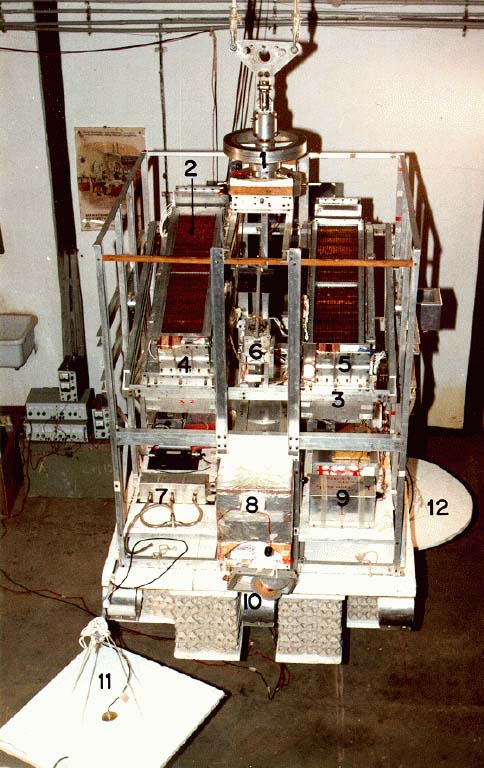
The entire instrument including the orienting system was enclosed in a pressurised gondola with a thinned top.
Details of the balloon flight
Balloon launched on: 4/28/1968 at 23:31 IST
Launch site: Osmania University Campus, Hyderabad, India
Balloon launched by: National Balloon Facility, Tata Institute of Fundamental Research
Balloon manufacturer/size/composition: Zero Pressure Balloon
End of flight (L for landing time, W for last contact, otherwise termination time): 4/28/1968 at 8:20 ist
Balloon flight duration (F: time at float only, otherwise total flight time in d:days / h:hours or m:minutes - ): F 5 h 40 m
In this maiden flight, observations of Sco X-1 were successfully carried out.
External references
- A balloon borne instrument for the study of cosmic X-rays Nuclear Instruments and Methods, Vol. 95, p. 29
- Balloon X-Ray Astronomy Experiments From India ISRO website
- Energy Spectra of Several Discrete X-Ray Sources in the 20-120 KE V Range Non-Solar X- and Gamma-Ray Astronomy, Proceedings from Symposium no. 37, 1969, Pag. 94
- Intensity and Energy Spectra of Several X-Ray Sources in the 20-150 KeV Energy Band 12th International Conference on Cosmic Rays, Vol.1, p.20
- Observations of Sco X-1 X-ray sources in the 16-111 keV range 11th International Conference on Cosmic Rays, 1969, Vol. 29 p. 277
- Observations on Diffuse Cosmic X-Rays in the Energy Range 20-120 KE V Non-Solar X- and Gamma-Ray Astronomy, Proceedings from Symposium no. 37, 1969, Pag. 289
- Smooth landing for experimental flight to study ozone level The Indian Express
- Stratified regions of high radioactivity in the atmosphere over Hyderabad, India, in April, 1968 Tellus, 23: 455458
- The Flattering of the X-Ray Spectrum of Sco X-1 at Energies beyond 40 keV Astrophysics and Space Science, Volume 10, Issue 3, pp.500
Images of the mission
If you consider this website interesting or useful, you can help me to keep it up and running with a small donation to cover the operational costs. Just the equivalent of the price of a cup of coffee helps a lot.