
Purpose of the flight and payload description
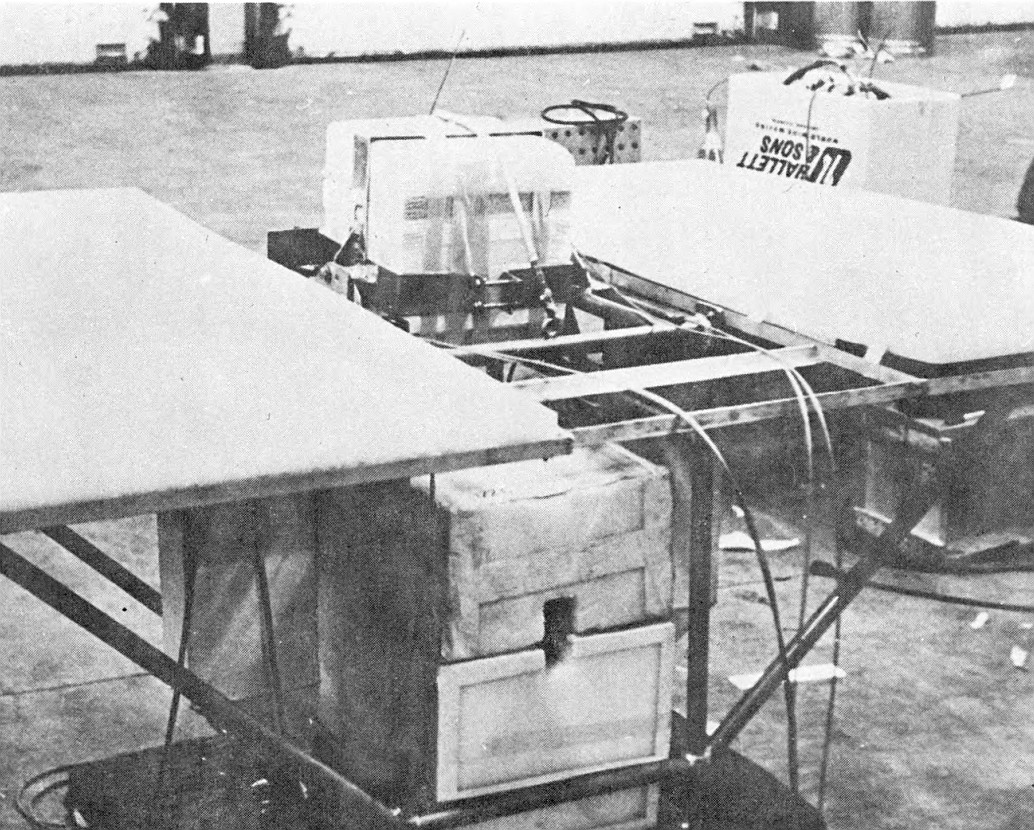
Objective of the flight was to expose large-area stacks of plastic nuclear track detectors and nuclear emulsions to galactic heavy nuclei. It was developed to evaluate the performance of plastic solid-state detectors under flight conditions while obtaining measurements of the charge and flux of heavy cosmic-ray particles. The instrument developed at the Space Physics Laboratory of the Air Force Cambridge Research Laboratory (AFCRL), combined cellulose nitrate, Lexan polycarbonate, and nuclear emulsions in a single detector assembly, allowing direct comparison between the plastic detector technique and conventional emulsion methods. It was flown from Fort Churchill because its high geomagnetic latitude provided access to low-energy galactic cosmic rays that are excluded at lower latitudes by the Earth's magnetic field. The lower geomagnetic cutoff rigidity allowed heavy nuclei with lower magnetic rigidity to reach balloon altitude, increasing the flux of particles capable of stopping within the detector stack.
The payload, which can be seen in the image at left, consisted of two large wing-like detector packages mounted symmetrically on opposite sides of a central structural frame. Each package contained eight sheets of cellulose nitrate (CN), thirty sheets of Lexan polycarbonate, and a set of nuclear emulsions. The wing configuration increased the collecting area while minimizing interference from the supporting structure. Both detector packages were identical, providing a larger effective exposure area and redundant measurements.
The detector stacks were assembled as multilayer sandwiches in which individual plastic sheets were accurately aligned through registration holes. These holes served both for mechanical assembly and for maintaining precise alignment during post-flight etching and microscopic analysis. The multilayer arrangement allowed a single particle to be followed through successive detector sheets, enabling reconstruction of its trajectory, penetration depth, residual range, and stopping point. The same registration system also simplified relocation of corresponding tracks during analysis.
The detector package was supported by Micarta base plates rather than the lighter materials used in smaller experimental stacks. The larger dimensions of the payload required a rigid backing capable of maintaining the alignment of the detector sheets throughout handling, flight, recovery, and laboratory processing. The Micarta structure provided sufficient stiffness while keeping the detector surfaces flat and preventing distortion of the multilayer assembly.
The combination of cellulose nitrate and Lexan extended the detectable charge range. Cellulose nitrate was used because of its lower detection threshold and its ability to record relatively lightly ionizing heavy particles. Lexan complemented it with a higher threshold and greater suitability for heavier nuclei. The nuclear emulsions provided an independent detector with different response characteristics, permitting comparison of particle identification and trajectory reconstruction between the two techniques.
During exposure, heavy cosmic-ray nuclei traversed successive detector layers, producing latent damage tracks within the plastic materials. After recovery, the detector sheets were chemically etched in controlled sodium hydroxide solutions. Because the damaged regions etched faster than the undamaged material, conical pits developed along each particle trajectory. Measuring the dimensions of corresponding pits through multiple sheets allowed determination of particle charge, residual range, and stopping position. The dimensional stability of the plastic detectors simplified these measurements compared with nuclear emulsions and improved the accuracy of track correlation across the detector stack.
Details of the balloon flight
Balloon launched on: 7/2/1968 at 3:34 utc
Launch site: Fort Churchill Airport, Manitoba, Canada
Balloon launched by: Raven Industries Inc.
Balloon manufacturer/size/composition: Zero Pressure Balloon Raven 10.600.000 cuft (Stratofilm 0,5 Mil - Cap. 0,5 Mil)
Balloon serial number: SF-305.86-050-NSC-13 Serial Nº 255
Flight identification number: 1226-N
End of flight (L for landing time, W for last contact, otherwise termination time): 7/2/1968 at 18:54 utc
Balloon flight duration (F: time at float only, otherwise total flight time in d:days / h:hours or m:minutes - ): 16 h 10 m
Landing site: Impact in coordinates 58º 56' N - 111º 6' W, Canada
Payload weight: 138 lbs
Overall weight: 1267 lbs
External references
- AFCRL Space Science Research during 1968 (annual report to COSPAR) Special reports, no. 84, 1 Jan-31 Dec 1968
- Preliminary results of measurements on track of heavy cosmic rays in plastic detectors 11th International Conference on Cosmic Rays, Vol.29 p. 391
- Raven flight sheet in Use and processing of nuclear emulsions as particle detectors, AFCRL Instrumentation Papers Nº 180, October 1972
If you consider this website interesting or useful, you can help me to keep it up and running with a small donation to cover the operational costs. Just the equivalent of the price of a cup of coffee helps a lot.