
Purpose of the flight and payload description
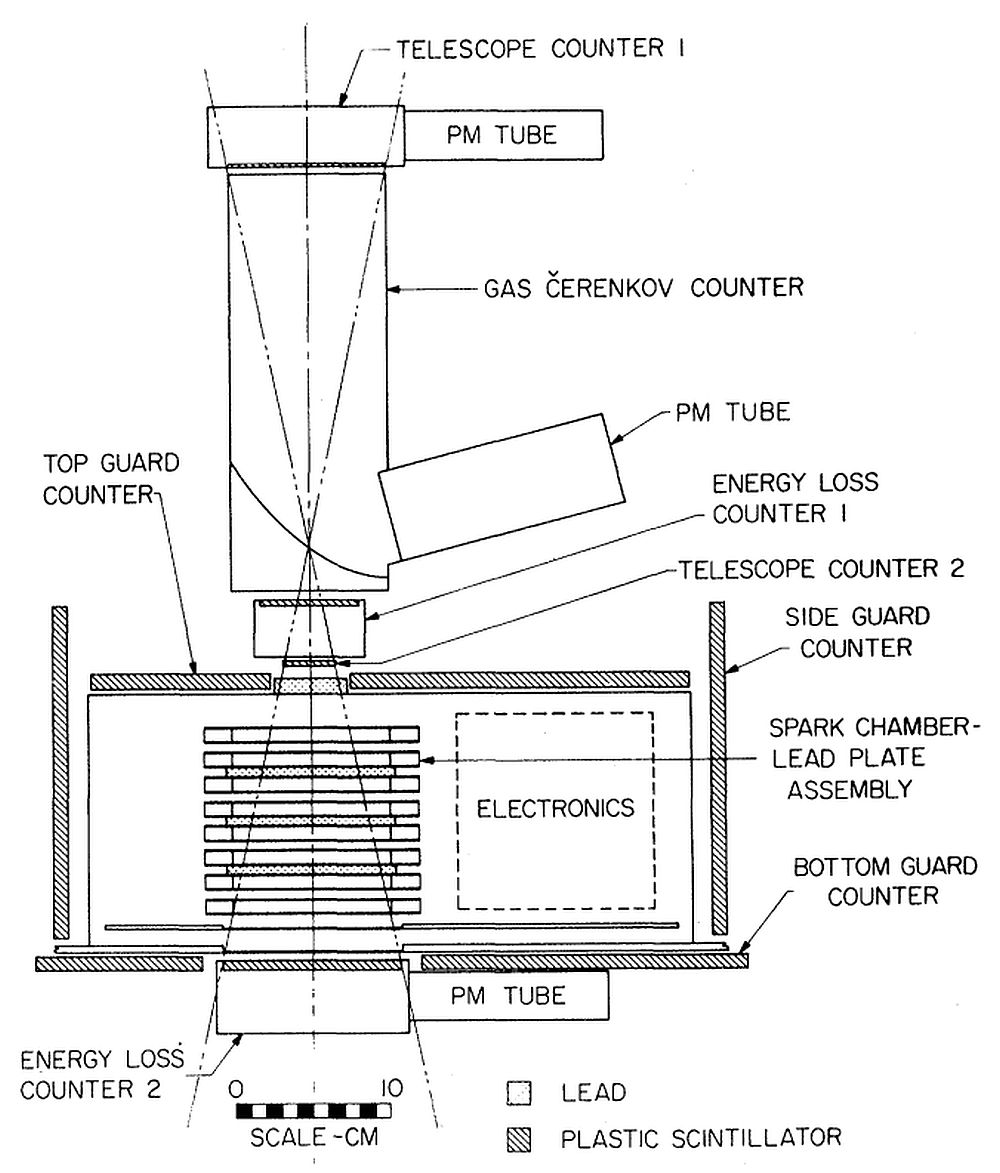
The mission goal was to measure the flux and energy spectrum of cosmic-ray electrons in the energy range from 12 MeV to 1 GeV, aiming to characterize the vertically incident primary electron flux at the top of the atmosphere, to quantify the contribution of atmospheric secondary electrons, and to measure both splash albedo and return albedo electron fluxes at different geomagnetic latitudes. The measurements were intended to provide information about the origin of cosmic-ray electrons, the degree of solar modulation affecting low-energy electrons, and the relationship between splash and return albedo intensities. The detector system was developed at the California Institute of Technology in late 60s decade.
In the scheme at left we can see all the elements that formed the detector (click to enlarge). The upper section of the instrument was formed by two plastic scintillation counters, designated as telescope counters T1 and T2, arranged in vertical alignment to define the geometrical acceptance of the telescope. These counters produced light pulses proportional to the energy deposited by traversing charged particles, which were subsequently converted into electrical signals by photomultiplier tubes. The coincidence of signals in T1 and T2 defined a particle trajectory within a conical acceptance region ensuring that only particles entering along near-vertical trajectories were analyzed, thereby enabling measurements of vertically incident fluxes.
Positioned between the scintillation counters was a gas Cherenkov detector filled with sulfur hexafluoride at a pressure of 2.2 atmospheres. This subsystem operated as a velocity threshold detector, producing Cherenkov radiation only for particles exceeding a critical velocity. For electrons, this threshold corresponded to a kinetic energy of approximately 8.6 MeV, whereas for protons it corresponded to approximately 15.8 GeV. The Cherenkov signal therefore provided an effective means of discriminating relativistic electrons from the far more abundant low-energy hadronic background. The requirement of a triple coincidence between T1, T2, and the Cherenkov counter constituted the primary event trigger condition.
Below the upper telescope assembly were placed two additional scintillation detectors, referred to as energy-loss counters AE1 and AE2. These elements measured the ionization energy loss of traversing particles. The signal from AE1 was used to verify that the particle carried a single unit of charge by comparing its pulse height with the expected minimum ionizing value. AE2 functioned as an independent sampling detector for secondary electromagnetic showers produced downstream in the absorber and spark chamber system. Together, these counters provided information on particle identity and interaction characteristics.
The central tracking and energy-discrimination component of the instrument was a multi-gap spark chamber interleaved with lead absorber plates. The chamber consisted of a stack of conductive plates separated by gas-filled gaps, across which high-voltage pulses were applied upon detection of a valid trigger event. Ionization trails left by charged particles initiated localized electrical breakdowns, producing visible sparks whose positions were recorded digitally. The chamber included an initial lead plate of 11.6 g/cm² thickness, equivalent to approximately two radiation lengths, followed by three additional plates of 5.8 g/cm² each interleaved within the chamber structure. These absorbers induced the development of electromagnetic cascades when electrons of sufficient energy entered the system. Particle identification was based on track patterns: low-energy electrons produced no sparks, high-energy electrons formed showers, and protons left single straight tracks, enabling separation of electromagnetic and hadronic events.
Surrounding the central detector assembly was a system of anticoincidence guard counters. These scintillation detectors enclosed the spark chamber and absorber stack on all sides except for the entrance aperture defined by the telescope. Their function was to veto events in which particles entered the detector from outside the acceptance cone or in which secondary particles escaped the interaction region efficiently reducing background, with over 90% of interacting protons detected.
The entire detector was coupled to an electronic data acquisition system that recorded pulse heights from the scintillation counters, coincidence logic states, and the spatial distribution of sparks within the chamber. Each event was classified according to its detector response, including the presence or absence of signals in AE1 and AE2, the development of cascades in the spark chamber, and the activation of guard counters. This classification scheme enabled the reconstruction of the energy spectrum of incident electrons and the systematic rejection of background events, yielding a reliable measurement of cosmic-ray electron fluxes over the targeted energy interval.
The entire instrument, was enclosed in an aluminum gondola, which was pressurized at one atmosphere. A 0.016-inch aluminum window above the detector system allowed the cosmic rays to penetrate the gondola with a minimum of scattering. The flight equipment had a total weight of 290 pounds.
Details of the balloon flight
Balloon launched on: 7/2/1967 at 3:58 utc
Launch site: Fort Churchill Airport, Manitoba, Canada
Balloon launched by: Raven Industries Inc.
Balloon manufacturer/size/composition: Zero Pressure Balloon 10.600.000 cuft
Flight identification number: C2
End of flight (L for landing time, W for last contact, otherwise termination time): 7/2/1967 at 17:45 utc
Balloon flight duration (F: time at float only, otherwise total flight time in d:days / h:hours or m:minutes - ): ~ 14 h
External references
- Characteristics of the diurnally varying electron flux near the Polar Cap Contractor Report (CR)
- Characteristics of the Diurnally Varying Electron Flux near the Polar Cap J. Geophys. Res., 74(19), 4714
- Cosmic-ray electrons between 12 Mev and 1 Gev in 1967 J. Geophys. Res., 74(19), 4701
- Flux of Cosmic-Ray Electrons Between 17 and 63 MeV Phys. Rev. Lett. 20, 1053 Published 6 May 1968
- Flux of Cosmic-Ray Electrons Between 17 and 63 MeV Phys. Rev. Lett. 20, 1053, 1968
- Primary cosmic ray electrons and albedo electrons in 1967 at energies between 12 and 1000 MEV. Martin H. Israel Dissertation (Ph.D.) - California Institute of Technology
- Primary cosmic-ray electrons between 17 MeV and 1 GeV in 1967 Contractor Report (CR)
If you consider this website interesting or useful, you can help me to keep it up and running with a small donation to cover the operational costs. Just the equivalent of the price of a cup of coffee helps a lot.