
Purpose of the flight and payload description

The mission was designed to evaluate the feasibility of conducting high-precision astronomical observations from the stratosphere using a manned balloon platform. Its primary scientific objective was to reduce atmospheric interference, particularly water vapor absorption and optical turbulence, by placing the observer and instrumentation above most of the Earth's atmosphere. The flight aimed to measure the residual water vapor content of the upper atmosphere and to improve spectropolarimetric observations of celestial bodies, including the Moon, Venus, and Mars, in support of studies of planetary atmospheres and the possible presence of water beyond Earth. Additional scientific objectives included characterizing the optical properties of the stratosphere, assessing the reduction of stellar scintillation at high altitude, and collecting observations of atmospheric structure, turbulence, and wind shear across the tropopause-stratosphere transition.
The flight was conceived, organized, and piloted by Audouin Dollfus, an astronomer at the Paris-Meudon Observatory. Dollfus designed the scientific program, developed the balloon-borne observatory concept, designed the optical system, conducted the observations, and operated the flight alone. The main sponsor for the mission was the Paris-Meudon Observatory (OPM), which supported the development of the telescope, instrumentation, and scientific objectives. The project also received support from the French National Centre for Scientific Research, particularly for the development and testing of the balloon system and associated technologies.
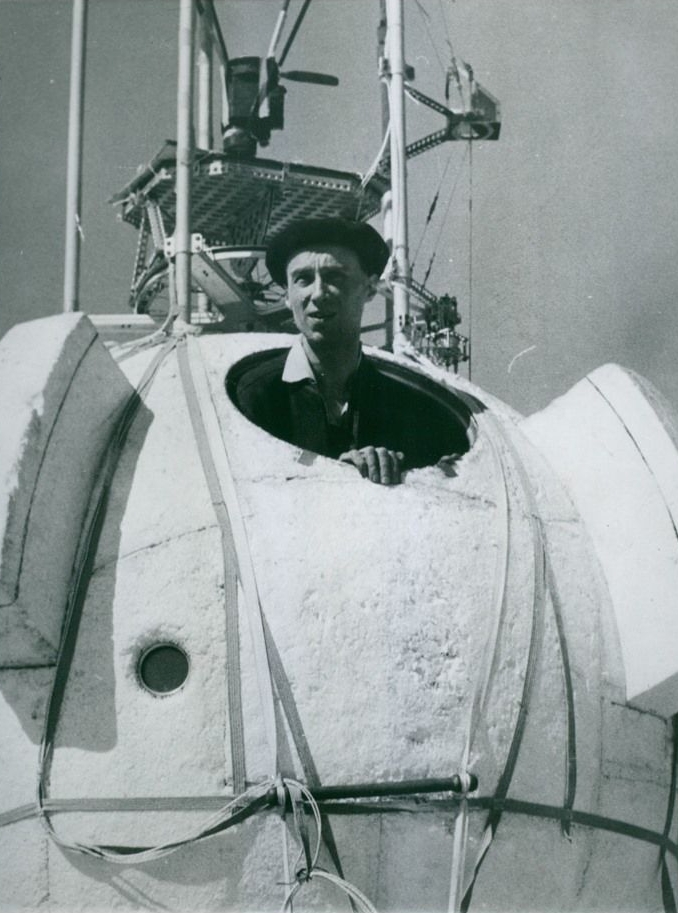
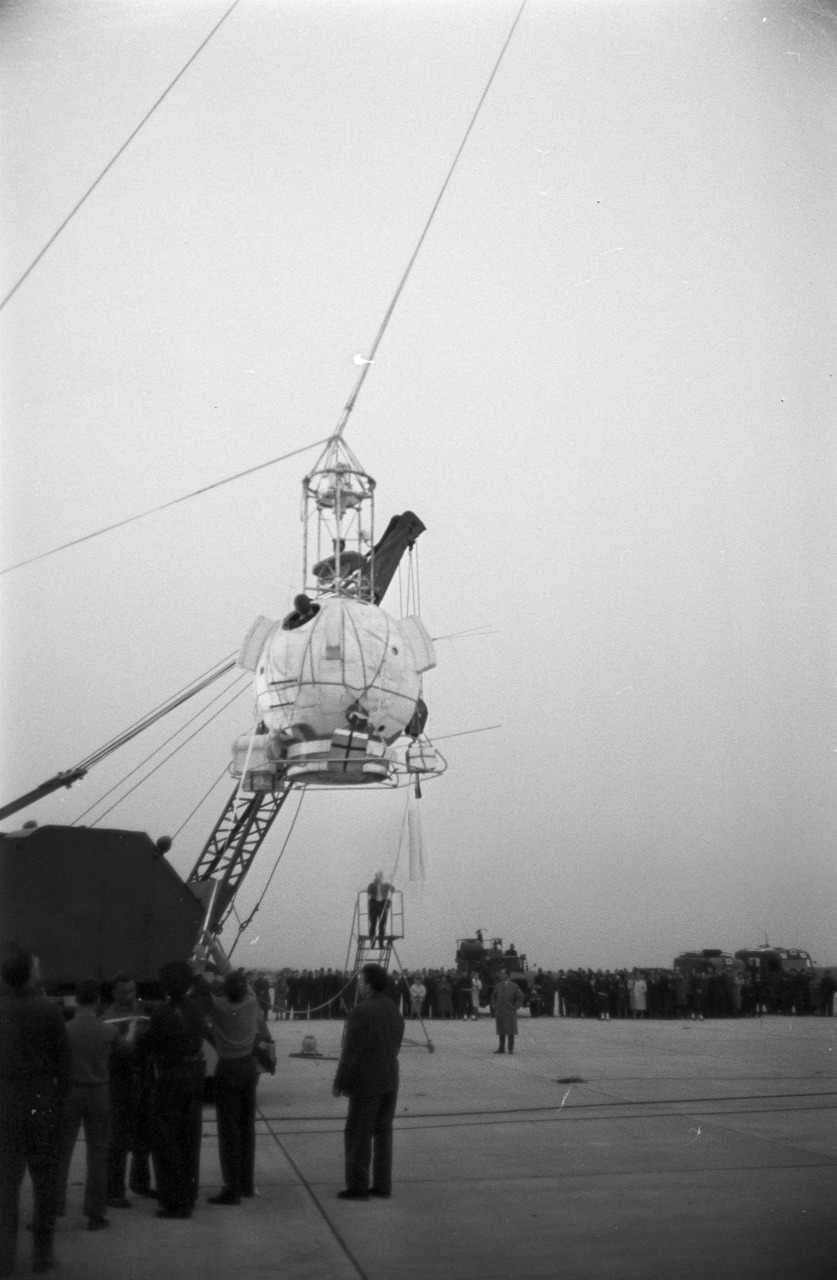
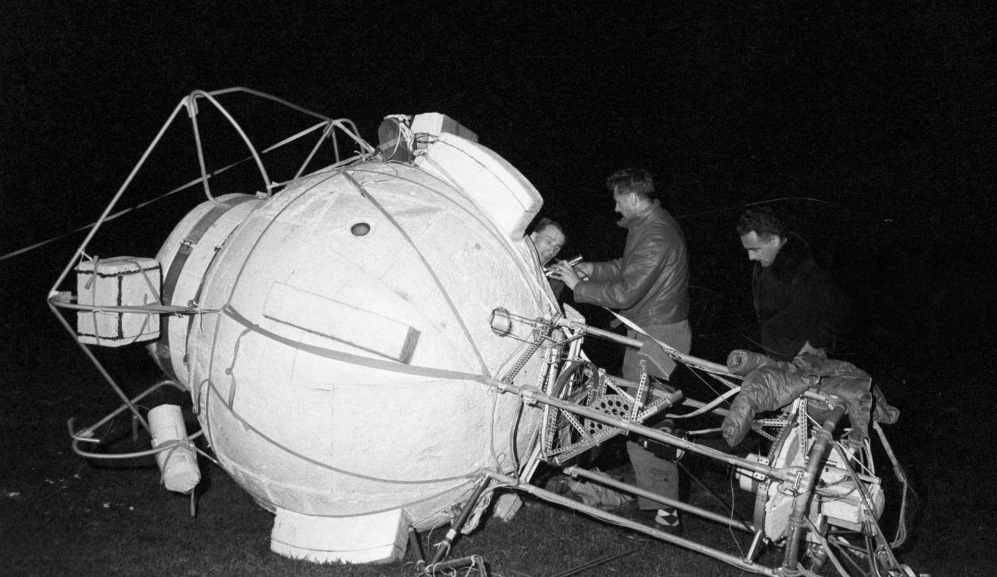
In the image at left we can see the capsule and associated systems. It was a single seat capsule manufactured by Aluminium Français with support from physicist Louis Leprince-Ringuet, the spherical capsule measured approximately 2 meters in diameter, had a wall thickness of only 1.2 mm, and weighed about 10 kg. The capsule could be sealed and pressurized during ascent, allowing operation at altitudes where atmospheric pressure was too low for normal human survival. It contained observation ports directed upward, downward, and toward the horizon, an oxygen supply system, a carbon dioxide removal unit, lighting, communications equipment, flight instruments, and a harness system to secure the pilot during launch, flight, and landing. The internal atmosphere was maintained by supplying pure oxygen, creating a safe breathing environment despite the reduced pressure.
Above the capsule was a telescope support structure constructed from aeronautical duralumin tubing, designed with advice from Professor Auguste Piccard. The telescope itself had a focal length of 50 cm, was approximately 3 meters long, and weighed about 100 kg. Rather than moving the telescope tube, the optical system employed a steerable mirror controlled manually by hand cranks. The observer aligned celestial targets through this mirror arrangement while viewing the image through a sealed periscope. The optical design allowed astronomical observations from the stratosphere while keeping the observer inside the pressurized capsule.
The payload also carried a spectropolarimeter used to measure water vapor absorption in the atmospheres of celestial bodies and in the Earth's upper atmosphere. An automatic triggering system activated measurements when the target entered the field of view. Additional equipment included altimeters, variometers, radio communication systems, radar tracking support, navigation instruments, photographic cameras, and ballast tanks filled with heated oil. The oil served both as ballast and as a source of heat for the capsule. The entire system, including the observer, telescope, instruments, structure, ballast, suspension system, and balloons, weighed approximately 500 kg.
Details of the balloon flight
Balloon launched on: 4/22/1959 at 20:10 local
Launch site: Villacoublay Air Force Base, Yvelines, France
Balloon manufacturer/size/composition: Beritex Cluster x 103
End of flight (L for landing time, W for last contact, otherwise termination time): 4/23/1959 at 1:16 local
Balloon flight duration (F: time at float only, otherwise total flight time in d:days / h:hours or m:minutes - ): 5 h 6 m
Landing site: Commune of Prémery, Nièvre department, France
Payload weight: 650 kg
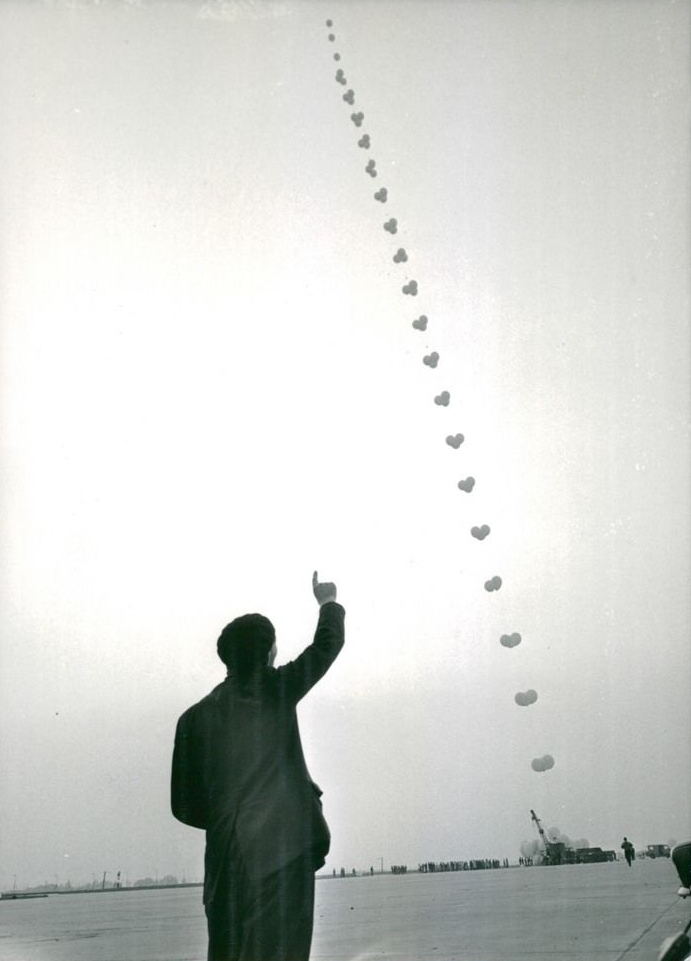
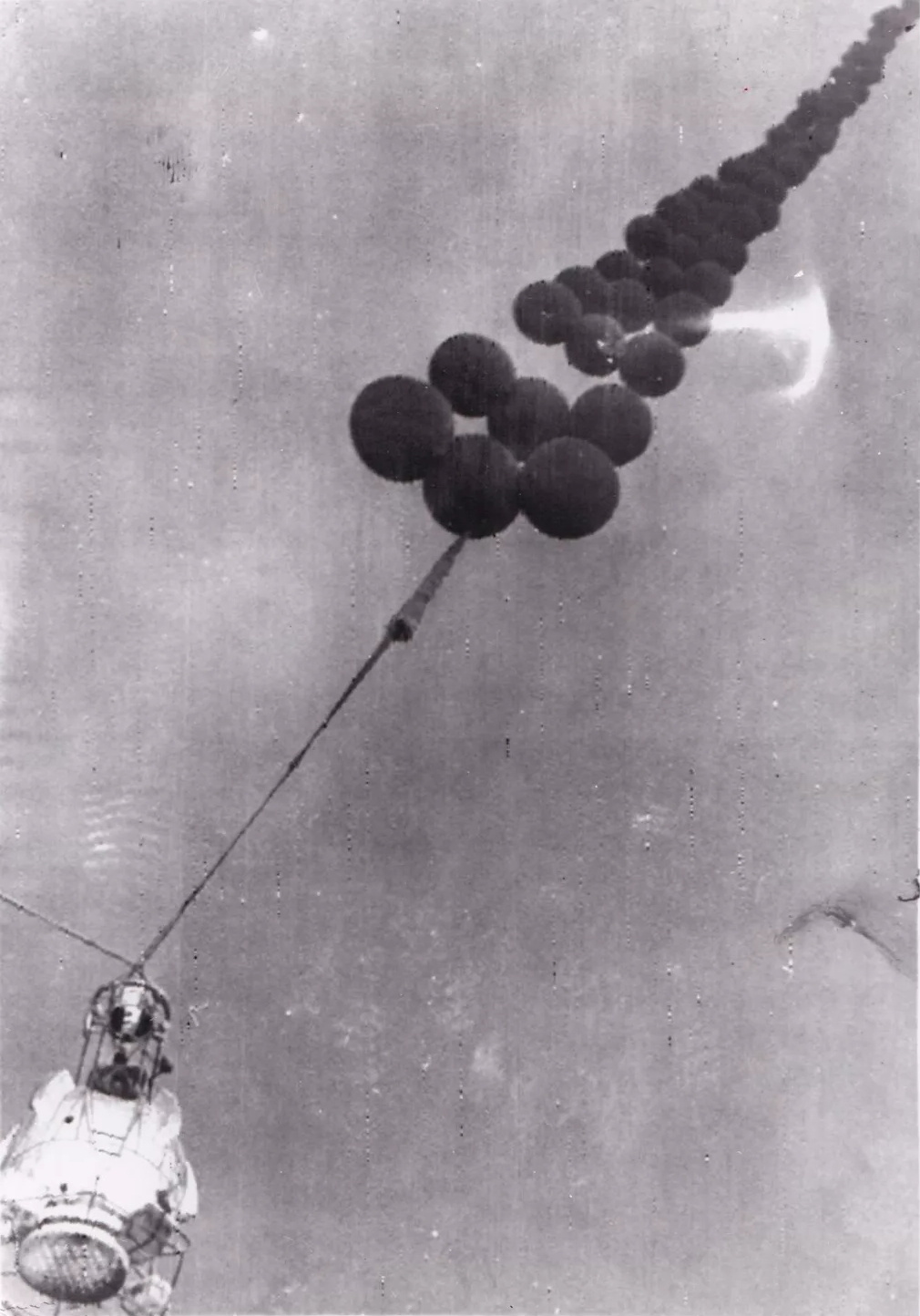
The flight took place from Villacoublay Air Base near Paris. The capsule was lifted by a vertical train of 105 hydrogen-filled polyurethane balloons attached along a nylon suspension line. Each balloon provided approximately 10 kg of lift. The complete assembly reached a height of about 450 meters from the uppermost balloon to the capsule. Because nearly one tonne of hydrogen was used for inflation, air traffic operations in the area were temporarily suspended during launch preparations.
At 20:05 local time on 22 April 1959 Dollfus released the final restraint and began ascending at about 2.5 m/s. During the first phase of flight he monitored the behavior of the balloon train and passed through layers of atmospheric turbulence. At 4,200 meters he began using supplemental oxygen. At 6,000 meters he sealed the capsule and pressurized it with pure oxygen, maintaining an internal environment equivalent to a much lower altitude. Ground stations at Trappes and Brétigny tracked the vehicle by radar and provided position reports.
As the balloon train climbed through 9,000 meters it encountered a strong high-altitude wind stream. Several balloons burst under the stresses generated by the wind. To prevent an uncontrolled descent, Dollfus released approximately 50 kg of heated oil ballast, restoring a positive climb rate. At about 9,500 meters he began observations of Venus using the spectropolarimeter. Although the planet was already low on the horizon, he successfully measured atmospheric water vapor above the balloon, obtaining a value lower than previous estimates for the upper atmosphere.
At approximately 11,000 meters he crossed the tropopause and entered the stratosphere. From this altitude he observed a sharply defined boundary separating the dusty lower atmosphere from the clear upper atmosphere. He reported a dark sky despite the presence of a full Moon and noted that stars no longer scintillated. While traversing regions of wind shear, he carefully observed the deformation of the balloon train and recorded the relative positions of the balloon groups. These observations provided information on atmospheric shear and turbulence, phenomena directly related to stellar scintillation.
Around 14,000 meters the ascent stabilized after additional ballast release. Roughly ten balloons had burst during the climb, but sufficient lift remained for operations. With the vehicle in stable equilibrium, Dollfus began the principal scientific observations. He shut down radio equipment and air purification machinery to eliminate electrical interference and used the telescope and spectropolarimeter to study the Moon. By repeatedly measuring absorption characteristics at different instrument settings, he derived values for the amount of condensable water vapor present in the stratosphere, obtaining estimates between approximately 0.010 and 0.015 g/cm².
The balloon remained near its ceiling altitude for more than an hour while drifting southward at about 60 km/h. After completing the scientific program, Dollfus initiated descent by radio-commanded pyrotechnic devices intended to detach groups of balloons. At first there was no visible response, but the system eventually functioned correctly, producing a controlled descent at approximately 2.5 m/s. During the descent he repeated lunar measurements at about 11,000 meters, confirming his earlier results.
At approximately 10,000 meters the vehicle left the stratosphere and reentered the troposphere. The telescope rapidly became unusable because moisture condensed and froze on the optical surfaces. As the balloon descended through 5,000 meters, the pressure inside and outside the capsule equalized and the hatch opened naturally. Dollfus prepared for landing by securing equipment, storing observation records, venting the oxygen supply, and fastening himself into the protective harness.
The landing occurred shortly after 01:15 on April 23, 1959. A guide rope hanging below the capsule touched the ground first, causing it to tip and drag across the surface. Dollfus immediately activated explosive devices that separated the remaining balloons from the payload. After the motion ceased, he exited the capsule in darkness and found himself in a field near the town of Prémery in the Nièvre department of central France. After walking through fields and into the village, he reached the local police station and informed his family of the successful completion of the mission.
External references
- 100-balloon jaunt helps scan Venus LIFE Magazine, May 18 1959, Page 76
- Audouin Dollfus Association pour un Centre Européen des Ballons et Dirigeables
- French Scientist's Multi-Balloon Design Scientific Ballooning Nº 3, March 1962, Pag. 6
- L'ascension en ballon du 22 avril 1959 d'Audouin Dollfus Observatoire de Paris
- L'Exploit inégalé d'Audouin Dollfus (Part 1) Magazine l'Astronomie, April 2009
- L'Exploit inégalé d'Audouin Dollfus (Part 2) Magazine l'Astronomie, April 2009
Images of the mission
If you consider this website interesting or useful, you can help me to keep it up and running with a small donation to cover the operational costs. Just the equivalent of the price of a cup of coffee helps a lot.